
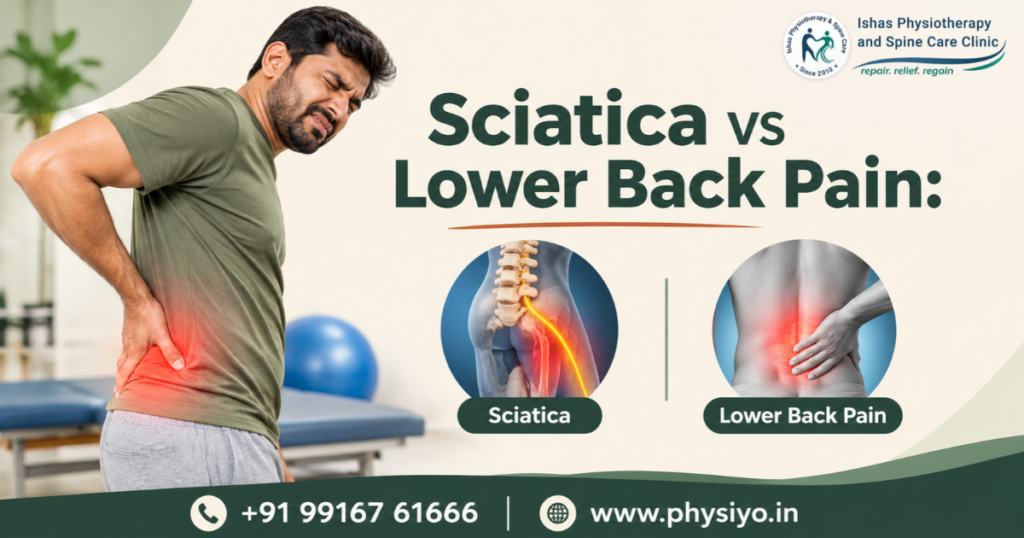
Lower Back Pain is one of the most common physical problems affecting people who spend long hours sitting, working, driving, or performing daily activities. But did you know that pain in your lower back could sometimes be related to sciatica?
Although sciatica and lower back pain can feel similar, they are not the same condition. Lower back pain usually affects the muscles, joints, or structures around the lower spine, while sciatica involves irritation of the sciatic nerve, which can cause pain to travel from the lower back into the hip and leg.
Understanding the difference between sciatica and lower back pain can help you recognise your symptoms and know when to seek professional care.
At Ishas Physiotherapy and Spine Care Clinic in Jayanagar, Bangalore, Dr. Mahesh G. and the physiotherapy team provide personalised physiotherapy care for people experiencing back pain, sciatica, spine-related problems, and movement difficulties.
Let’s understand how these two conditions differ, what causes them, and how physiotherapy may help.
What Is Lower Back Pain?
Lower back pain refers to discomfort or pain in the lumbar region, which is the lower part of your spine between the ribs and hips.
It can develop suddenly after lifting something heavy or gradually due to prolonged sitting, muscle strain, poor movement habits, or age-related changes.
Common symptoms of lower back pain include:
- Pain or stiffness around the lower back.
- Discomfort while sitting or standing for long periods.
- Difficulty bending forward or lifting objects.
- Muscle tightness around the waist and lower spine.
- Pain after waking up or following physical activity.
- Difficulty performing everyday activities.
Lower back pain may be mild or severe depending on its underlying cause. Some cases improve with appropriate movement and self-care, while persistent or recurring pain may require professional assessment.
What Is Sciatica?
Sciatica is a condition involving irritation or compression of the sciatic nerve. This nerve starts in the lower spine, passes through the hip and buttock area, and travels down each leg.
When the nerve becomes irritated, pain can travel from the lower back or buttock into the thigh, calf, or foot.
Common symptoms of sciatica include:
- Pain travelling from the lower back into the buttock or leg.
- Burning or shooting pain along the leg.
- Tingling or a pins-and-needles sensation.
- Numbness in parts of the leg or foot.
- Pain that becomes worse after prolonged sitting.
- Weakness in the affected leg or foot.
Sciatica usually affects one side of the body, although symptoms can vary depending on the underlying cause.
Sciatica vs Lower Back Pain: What Is the Difference?
Understanding the symptoms can help you identify whether your discomfort may be related to ordinary lower back pain or sciatic nerve irritation.
| Symptoms | Lower Back Pain | Sciatica |
| Pain location | Mainly lower back | Lower back, buttock and leg |
| Pain type | Aching, stiffness or soreness | Shooting, burning or electric-like pain |
| Leg pain | May occur | Commonly travels down the leg |
| Tingling | Less typical | Can occur |
| Numbness | Less typical | Can occur |
| Sitting discomfort | Common | Can increase nerve-related symptoms |
| Muscle weakness | Depends on the cause | May occur in the affected leg or foot |
Important: These symptoms can overlap. Lower back pain and sciatica can also occur together. A proper assessment is needed to understand the possible cause.
What Causes Lower Back Pain and Sciatica?
Both conditions can develop due to different factors affecting the muscles, joints, discs, and nerves around the spine.
1. Prolonged Sitting
Spending several hours sitting at a desk, working on a laptop, or driving can contribute to muscle stiffness and discomfort around the lower back.
2. Poor Posture and Movement Habits
Repeatedly sitting in an uncomfortable position, bending incorrectly, or maintaining the same posture for extended periods may increase stress on the lower back.
3. Muscle Strain
Sudden movements, heavy lifting, exercise without proper preparation, or repetitive physical activities can strain the muscles supporting the spine.
4. Slipped or Herniated Disc
A herniated disc occurs when the soft inner material of a spinal disc pushes through its outer layer. In some cases, it can irritate nearby nerves and contribute to sciatica symptoms.
5. Age-Related Spinal Changes
Natural changes in spinal discs and joints may sometimes contribute to back pain or nerve irritation.
6. Reduced Core Strength
Weakness in the muscles supporting the abdomen, pelvis, and spine may affect movement control and contribute to recurring back discomfort.
How Can You Identify Whether Your Pain Is Sciatica?
Ask yourself these simple questions:
- Does the pain travel from your lower back towards your buttock or leg?
- Do you experience tingling or numbness in your leg or foot?
- Does sitting for a long time increase your discomfort?
- Do you experience burning or shooting pain along one leg?
- Does your leg sometimes feel weak?
If you experience these symptoms, sciatica may be one possible explanation.
However, these questions are not a diagnosis. A physiotherapist or other qualified healthcare professional can assess your symptoms, movement, strength, and medical history to understand what may be causing the pain.
When Should You See a Physiotherapist?
Many people ignore back pain, hoping it will disappear on its own. However, recurring discomfort or pain that affects everyday activities should not be overlooked.
Consider consulting a physiotherapist if:
- Your lower back pain keeps returning.
- Pain affects your ability to sit, stand, or walk comfortably.
- You experience pain travelling from your back into your leg.
- You notice tingling or numbness in your leg.
- Back stiffness affects your daily routine.
- You find it difficult to bend, lift, or perform normal activities.
- Your pain limits your exercise or physical activity.
Important medical warning: New loss of bladder or bowel control, numbness around the groin or saddle area, or rapidly worsening or severe weakness in both legs can indicate a serious spinal problem. Seek emergency medical attention immediately rather than waiting for a physiotherapy appointment.
How Can Physiotherapy Help With Sciatica and Lower Back Pain?
Physiotherapy can play an important role in managing many types of lower back pain and sciatica. The treatment approach depends on the underlying cause, symptoms, physical condition, and individual rehabilitation goals.
At Ishas Physiotherapy and Spine Care Clinic, physiotherapy care may include the following approaches based on the patient’s assessment.
1. Detailed Physiotherapy Assessment
The physiotherapist evaluates your pain location, movement, posture, flexibility, muscle strength, and functional limitations to understand your condition.
2. Therapeutic Exercises
Individualised exercises may help improve flexibility, strengthen supporting muscles, and restore comfortable movement.
3. Core Stabilisation Exercises
Core exercises help strengthen the muscles that support the spine and pelvis. Better core control can support posture, movement, and everyday activities.
4. Spinal Manual Therapy
Appropriate hands-on techniques may help manage stiffness and improve movement when clinically indicated.
5. Electrotherapy
Electrotherapy may be used as part of a broader physiotherapy programme to help manage pain and support rehabilitation.
6. Posture and Movement Education
Learning appropriate sitting, standing, bending, and lifting techniques can help reduce unnecessary stress on the lower back.
The right treatment depends on your individual condition. Not every treatment is suitable for every patient.
Why Choose Ishas Physiotherapy and Spine Care Clinic in Jayanagar, Bangalore?
When back pain or sciatica starts affecting your daily life, getting the right assessment and rehabilitation guidance matters.
Ishas Physiotherapy and Spine Care Clinic provides personalised physiotherapy services for people experiencing spine-related conditions, back pain, muscle pain, and movement difficulties.
Under the guidance of Dr. Mahesh G., the clinic focuses on understanding individual patient needs and developing appropriate treatment and rehabilitation plans.
The clinic provides physiotherapy services including:
- Sciatica Pain Treatment
- Lower Back Pain Treatment
- Slip Disc and Disc Prolapse Treatment
- Core Stabilisation Exercises
- Spinal Rehabilitation
- Muscle Pain Treatment
- Cervical Pain Treatment
- Sports Injury Rehabilitation
Whether you experience discomfort after long working hours, recurring lower back stiffness, or pain travelling into your leg, a professional physiotherapy assessment can help you understand your condition and suitable treatment options.
Conclusion: Don’t Ignore Persistent Back Pain – Get the Right Physiotherapy Care
Sciatica and Lower Back Pain may share similar symptoms, but understanding the difference is important for choosing the right care. While lower back pain mainly affects the lumbar region, sciatica can cause pain, tingling, numbness, or weakness that travels from the lower back into the leg.
Ignoring recurring pain or continuing activities that make your symptoms worse may affect your daily routine and mobility. Early assessment and an appropriate physiotherapy programme can help you manage symptoms, improve movement, and work towards better spinal health.
At Ishas Physiotherapy and Spine Care Clinic in Jayanagar, Bangalore, Dr. Mahesh G. provides personalised physiotherapy guidance based on individual patient needs and physical conditions.
If you are experiencing persistent lower back pain, shooting leg pain, or possible sciatica symptoms, consult a qualified physiotherapist to understand the cause and suitable treatment options.
Take the first step towards better movement and a healthier back with Ishas Physiotherapy and Spine Care Clinic.
Location: Jayanagar, Bangalore
Call: +91 9916761666
Website: https://physiyo.in/
Frequently Asked Questions
1. How can I tell if I have sciatica or regular lower back pain?
Regular lower back pain usually affects the lower spine, while sciatica can cause shooting, burning, or tingling pain that travels from the lower back or buttock into one leg.
2. Can sciatica cause pain in the hip and leg?
Yes. Sciatica can cause pain that travels through the buttock, hip, thigh, calf, and sometimes the foot. Some people may also experience numbness or tingling.
3. Can physiotherapy reduce sciatica and lower back pain?
Physiotherapy may help manage symptoms, improve flexibility, strengthen supporting muscles, and restore movement. Treatment depends on the underlying cause and individual assessment.
4. Is prolonged sitting a cause of sciatica?
Prolonged sitting can aggravate symptoms in some people with sciatica and may contribute to back discomfort. Regular movement breaks and appropriate exercise can help.
5. When should I visit a physiotherapist for back pain in Jayanagar, Bangalore?
Consider consulting a physiotherapist if back pain keeps returning, affects walking or sitting, or travels into your leg. For new bladder or bowel control problems, saddle-area numbness, or rapidly worsening leg weakness, seek emergency medical attention immediately.